
ISO 27001 audit timeline: How long does certification really take?
This guide walks through the full ISO 27001 timeline, from preparation to certification, explaining audits, delays, planning and post-certification requirements clearly.
Key takeaways
ISO 27001 certification is a structured journey, not a quick audit. While audit days are measured in days, the full certification process usually takes several months.
The biggest delays rarely come from the audit itself. They usually happen when organisations rush preparation, leave Stage 1 findings unresolved, or struggle to produce clear, organised evidence at Stage 2.
A clear scope, genuine control implementation, and realistic scheduling lead to predictable timelines and a smoother path to certification.
Understanding the ISO 27001 audit timeline
Understanding the schedule and timeline of an ISO 27001 audit is key to a smooth certification. Whether you are planning your first audit or estimating the full journey, it is important to separate the two timelines.
The audit duration refers to the number of days the auditor formally assesses your ISMS.
The certification journey covers the wider process, which usually takes several months and includes preparation, internal audits, and corrective actions.
When organisations ask how long ISO 27001 certification takes, the honest answer is this: timelines depend on readiness, not shortcuts or speed-first claims.
What does a typical ISO 27001 audit day look like?
One of the biggest concerns organisations have is what an audit day actually feels like. In a conventional on-site audit, you would typically sit with the auditor from 9 am to 5 pm while documents are reviewed in real time.
That model works, but it can feel disruptive - particularly for senior leaders wearing multiple hats. Remote audits at Tempo work differently from the traditional on-site model.
Most of our clients gather their evidence in advance. This might sit inside GRC platforms (such as Vanta, Drata, Secfix, Kertos, Adoptech or Probo), or within well-organised Notion workspaces, Google Drive folders, or SharePoint sites.
The Tempo Audits remote audit flow
Instead of requesting documents one by one while you sit in a meeting room, we flip the process:
You share access to your organised evidence repository.
The auditor reviews policies, procedures, risk assessments, logs, and records independently.
Focused live sessions are scheduled to clarify points or discuss findings.
You continue running your business while the auditor works through the documentation.
This approach aligns with guidance for remote auditing under UKAS and the requirements set out in ISO/IEC 27006, ensuring rigour is never compromised.
What this looks like in practice
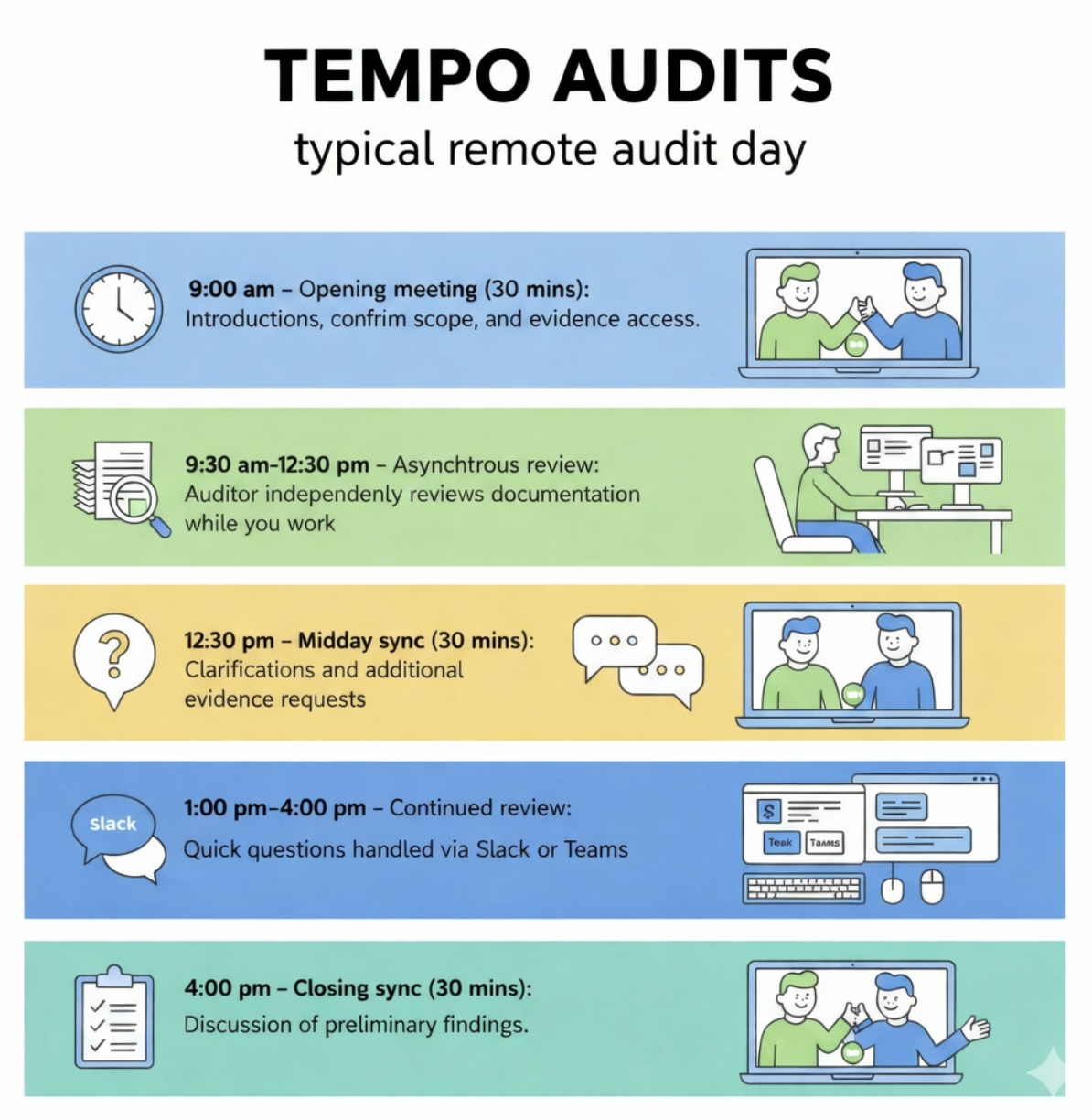
A typical remote audit day often runs within a 9 am–5 pm UK window, but your active involvement is usually limited to focused sessions:
9:00 am – Opening meeting (30 mins): Introductions, confirm scope, and evidence access.
9:30 am-12:30 pm – Asynchronous review: Auditor independently reviews documentation while you work.
12:30 pm – Midday sync (30 mins): Clarifications and additional evidence requests.
1:00 pm-4:00 pm – Continued asynchronous review: Quick questions handled via Slack or Teams.
4:00 pm – Closing sync (30 mins): Discussion of preliminary findings, requests for more evidence.
The one caveat we always give is that we need clients to remain available throughout the day to support our auditors in case they need additional support or have questions.
Why remote?
Designed for busy tech teams - In many growing companies, ISO 27001 sits with senior leaders rather than a dedicated compliance team. Remote auditing respects limited time and competing priorities.
Asynchronous review - Evidence is shared in advance, allowing auditors to review policies, logs, and records independently before focused discussions.
Less disruption - You attend short, structured sessions instead of being tied up in meetings all day.
Flexible format - Choose fully asynchronous, fully synchronous, or a hybrid model based on how your team works best.
Supports distributed teams - Team members can join from different cities or countries without travel logistics.
Lower overall cost - No additional expenses for auditor travel, accommodation or on-site arrangements.
Reduced environmental impact - Eliminating travel cuts carbon emissions while maintaining full audit rigour.
How audit length is calculated
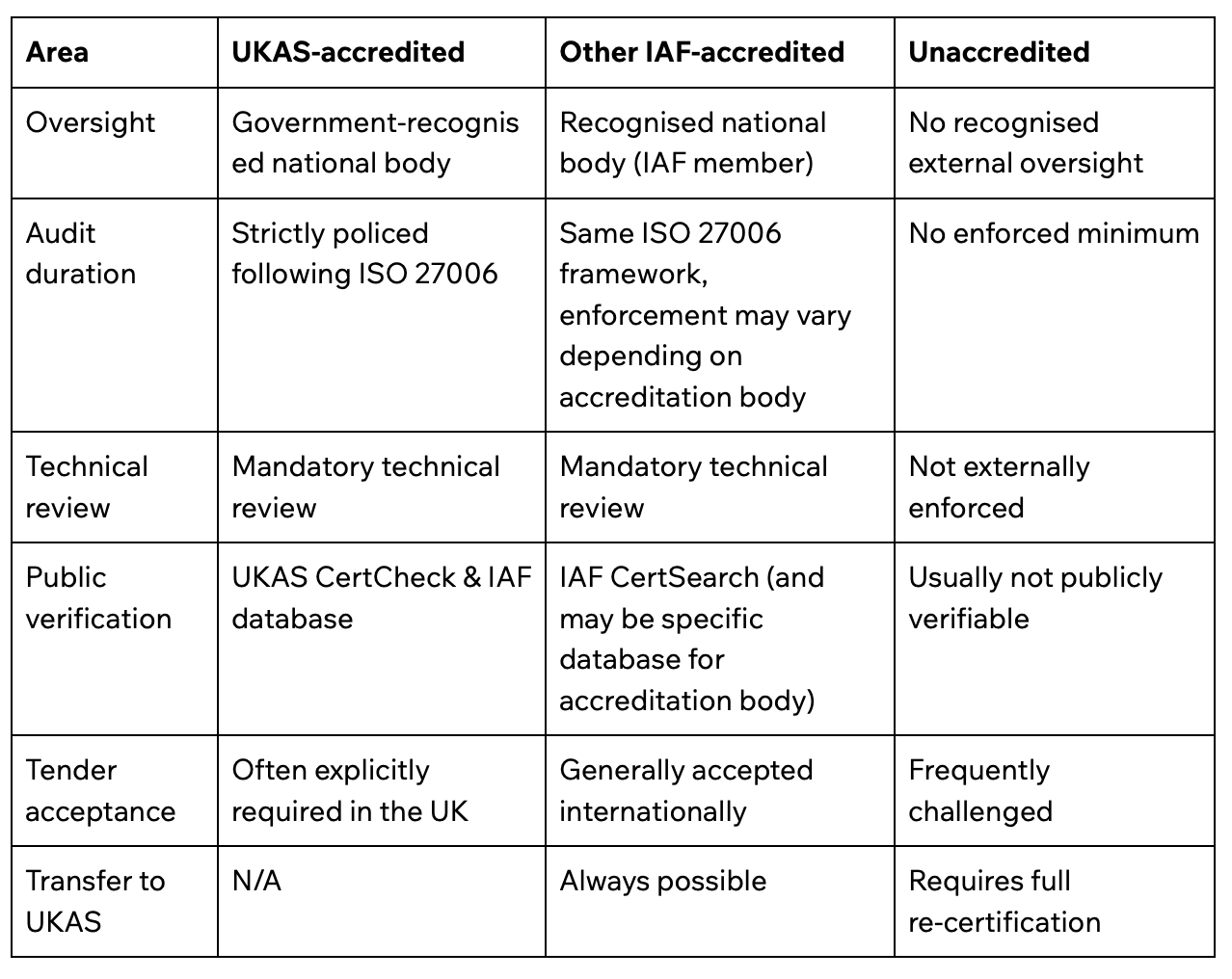
Audit duration is not guessed or shortened for convenience. For a UKAS-accredited certification body, it is always calculated using the framework set out in ISO/IEC 27006.
This standard sets minimum audit time requirements to ensure assessments are thorough and consistent. Without a mandated minimum time, audits could be rushed, reducing confidence in the certificate issued.
The calculation considers:
Organisation size - primarily the number of employees within scope.
Number of sites - including remote or multi-location operations.
Scope boundaries - what parts of the business are included.
Complexity of the ISMS - technical environments, cloud infrastructure, outsourced processes and regulatory exposure.
The result is a defined number of audit days split across Stage 1 and Stage 2.
How long does it take to get ISO 27001 certification?
From initial implementation to certificate issue, ISO 27001 typically takes 3 to 12 months. This includes building your ISMS, completing risk assessment and treatment, implementing controls, running an internal audit and holding management review - not just the external audit.
Note: Audit days are measured in days. Certification is measured in months.
Typical timelines:
SMEs: 3-6 months
Larger organisations: 6-12+ months due to broader scope
With Tempo Audits, the formal audit phase for an SME lasts around 3-4 weeks: Stage 1, a 3-week gap, Stage 2, and then certification issued about one week later.
Typical ISO 27001 certification timeline (End-to-end)
1. Preparation & readiness (1-3+ months)
This is the foundation stage.
You will:
Define the scope of your ISMS
Conduct risk assessment and risk treatment
Implement Annex A controls
Produce policies and procedures
Generate evidence that controls are operating
Hold a management review
Good preparation means controls have been working for weeks or months, not days.
2. Internal audit (Dry run - around month 4)
A complete internal audit is mandatory under ISO 27001 (Clause 9.2).
It must:
Cover the full ISMS scope
Be documented properly
Identify and track findings
Best practice is to complete the internal audit before Stage 1. When internal audits are skipped, rushed, or incomplete, Stage 2 often results in major non-conformities and delays.
3. Stage 1 audit (Document review – around month 5)
Stage 1 assesses readiness.
The auditor reviews:
ISMS documentation
Risk assessment and treatment plan
Statement of Applicability alignment
Internal audit and management review records
Stage 1 may raise gaps or opportunities for improvement. These must be genuinely resolved before Stage 2. If not, they frequently become formal non-conformities later, extending your timeline.
4. Stage 2 audit (Implementation & effectiveness – around month 5.5)
Stage 2 is where certification is earned. It tests whether your controls operate effectively in practice.
The auditor will:
Interview control owners
Sample logs and system configurations
Review monitoring activities
Verify evidence of control operation
This is also where timelines most commonly extend - and almost always due to preparation gaps.
Common causes include:
Policies exist, but controls have not been implemented (for example, no access reviews have been performed or an incident log maintained).
Risk assessments created once and not reviewed
Training documented but not completed
Evidence scattered across tools and difficult to access
Stage 1 findings left unresolved
Internal audit incomplete or poorly executed
Key personnel unavailable during audit
When this happens, organisations must implement fixes, allow controls to operate, gather evidence, and undergo verification. This can add months in a traditional certification body, although Tempo is normally quite fast-moving to close them out with customers over the course of a week or so after the audit.
Certification decision (Around month 6)
After Stage 2:
Findings are reviewed
Corrective actions (if any) are verified
An independent reviewer confirms the certification decision
The certificate is issued (valid for 3 years, subject to surveillance audits)
Factors that affect your ISO 27001 timeline
Several practical factors influence how long the ISO 27001 process takes. Most delays are predictable - and preventable.
Scope of your ISMS - The more teams, systems, and locations included, the longer the implementation and audit will take.
Security maturity - If core controls already operate effectively, timelines shorten significantly.
Statement of Applicability quality - A clear, accurate SoA aligned to implemented controls avoids confusion and rework at Stage 1 and Stage 2.
Management involvement - Active leadership engagement keeps risk reviews, approvals, and corrective actions moving. Passive oversight slows everything down.
Team availability - Key control owners must be available during preparation and audit. Holidays, product launches, and operational firefighting often extend timelines.
Evidence organisation - Disorganised logs, training records, or access reviews are one of the biggest causes of extended audit days. A structured central repository makes a measurable difference.
Tooling and automation - Platforms such as Vanta or Drata can accelerate preparation, but only if controls are genuinely implemented.
Remediation buffer planning - Build a realistic time between Stage 1 and Stage 2 to resolve findings properly. Optimistic scheduling is one of the most common pre-audit delays.
Can you speed up the ISO 27001 certification? (Without cutting corners)
Yes, you can move faster - but the biggest variation in speed happens during implementation, not the audit itself.
Some organisations complete the implementation journey in as little as 1 to 2 months. Others take a year or more. The difference usually comes down to how structured and realistic the preparation phase is.
You can accelerate implementation by:
Leveraging experienced consultants who understand common pitfalls
Using in-house knowledge effectively rather than reinventing processes
Adopting platforms that streamline documentation and evidence gathering
Allocating more internal time and resources to implementation
Although tools support preparation, they do not make certification easier or bypass audit rigour.
Real acceleration comes from defining a clear scope, producing a clean and accurate Statement of Applicability, properly implementing controls, and ensuring stakeholders are available.
Tempo Audits supports efficiency by booking audits quickly, shortening the gap between Stage 1 and Stage 2, and reviewing corrective actions promptly - often issuing certificates within a week of Stage 2 completion.
What happens after certification?
Annual surveillance audits - Each year, auditors review key parts of your ISMS to confirm controls are still operating effectively. These are shorter than the initial audit but remain thorough.
Ongoing ISMS monitoring - You must continue internal audits, risk reviews, management reviews, and corrective actions. ISO 27001 requires continuous improvement, not a one-time setup.
Full recertification every 3 years - A complete reassessment of your ISMS is required to renew certification for the next cycle.
Why planning matters more than speed in ISO 27001 certification
When people focus only on “how fast can we get certified?”, they often forget the real driver of a smooth timeline: quality of planning and readiness. Rushing into audits without a clear scope, accurate documentation, and real control implementation almost always leads to delays, not faster certification.
Tempo Audit’s approach focuses on predictable, human-centred audit planning rather than speed for speed’s sake. That means:
Predictable timelines - We plan your audit based on your ISMS maturity, not wishful dates.
No “surprise days” - You’ll know exactly what will be reviewed and when.
UKAS credibility maintained - We follow accredited standards, so your certificate stands up to scrutiny.
Remote-first, human-led auditing - Efficient but flexible, respecting your team’s time and availability.
Related read - Everything you need to know ahead of your ISO 27001 audit
Take the next step towards certification!
If you’re mapping out your ISO 27001 journey, the next step is simple: get clarity on your scope, audit duration, and realistic timeline.
At Tempo Audits, we keep the process transparent, structured, and predictable from the outset. Request a quote today and take the next practical step towards ISO 27001 certification with confidence.
FAQs
-
No, compliance software does not guarantee faster certification. Good platforms can help you structure implementation, manage tasks, track risks, and automate evidence collection, which might make implementation faster. They also make it easier for auditors to locate evidence quickly.
However, software cannot replace proper control implementation. Certification depends on controls operating effectively - not on the platform used to document them.
-
Some level of involvement is required on all audit days. However, because Tempo operates remotely and uses an asynchronous approach, your time commitment is reduced.
A nominated representative should be available during audit days, but we aim to review documentation independently and schedule focused sessions only where clarification or discussion is needed.
-
The most common cause of delay is a lack of genuine implementation.
Policies may be written, but controls are not operating in practice.
Incomplete risk assessments, missing internal audits, unresolved Stage 1 findings, and disorganised evidence also extend timelines.
Slow responses to corrective actions after Stage 2 can further delay the certificate issue.
In most cases, delays are preparation-related rather than audit-related.