SOC 2 certification: How much does a SOC 2 audit cost in 2026?
This article breaks down the real cost of SOC 2 certification for UK and European companies, explaining what drives audit fees, hidden expenses, and long-term maintenance. It also shows when SOC 2 delivers commercial value, how buyer expectations are changing, and how businesses can control costs without weakening audit outcomes.
Key takeaways
- The SOC 2 certification cost is not just the audit fee. For UK and European companies, internal effort, tooling, legal updates, and ongoing maintenance often drive total costs far beyond initial audit quotes.
- SOC 2 delivers the most value when it supports sales and buyer expectations. For companies targeting US or enterprise customers, Type 2 is increasingly the default and can directly reduce deal friction and delays.
- SOC 2 costs stay manageable with disciplined scoping and the right audit partner. Tech-aware auditors, realistic use of automation, and clear internal ownership prevent hidden overruns and long-term budget creep.
What does “SOC 2 certification cost” actually include?
When people ask about SOC 2 certification cost, they are usually expecting a single price. In reality, SOC 2 is not a product you buy off the shelf. It is a process, and the total cost is made up of several different parts.
Note: In the table below, all costs are shown in pounds (£), with euros (€) in brackets. Figures reflect UK/Europe market conditions and Tempo Audits’ audit experience.
Note: There’s a common misconception with people assuming SOC 2 certification applies to individuals, whereas SOC 2 applies to organisations rather than people, and the cost depends on a company’s systems, controls, and audit scope.
Explanation: What the SOC 2 certification cost includes
When budgeting for SOC 2, it helps to clearly separate what you pay to the audit firm from the internal and operational costs of preparing for the audit. These are two different cost categories, and they should not be confused.
1. What you pay to the auditor (The formal certification cost)
The audit fee is the only mandatory external payment required to obtain a SOC 2 report. This is paid to an independent SOC 2 audit firm to review your controls, test evidence, and issue the final report.
For UK and Europe-based organisations:
- Small to mid-sized businesses: £10,000–£20,000 (€11,000–€22,000)
- Large or complex enterprises: £30,000–£100,000+ (€35,000–€110,000+)
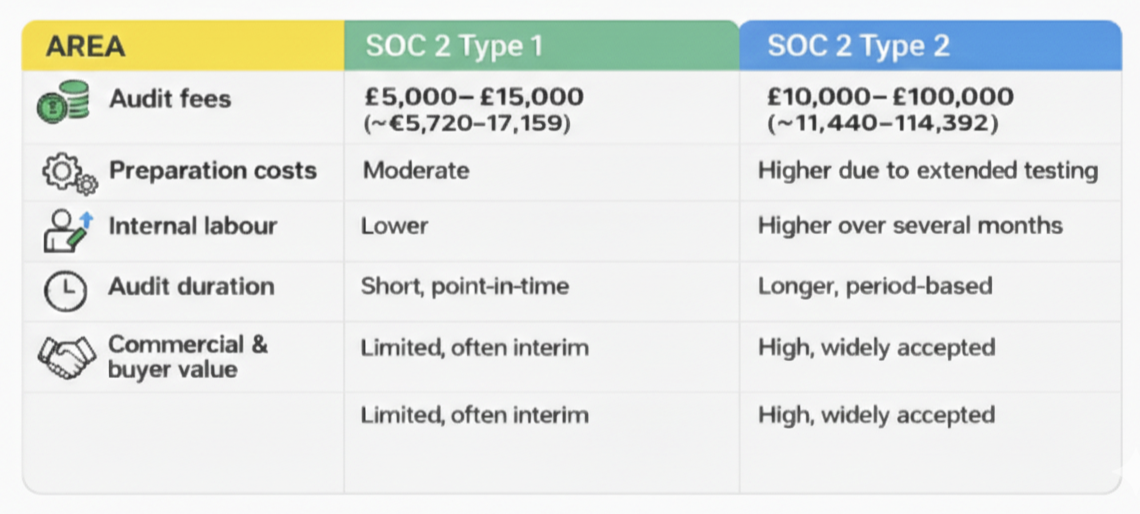
If you are pursuing SOC 2 Type 1, the audit-only cost typically sits at the lower end of this range, often around £5,000–£15,000 (~€11,000–€16,500) for smaller organisations.
Type 2 audits cost more because controls are tested over an extended observation period.
Note: You’ll find many estimates on the internet in USD. It is advisable not to directly convert them into pounds or euros. UK and European audit fees often differ from US estimates due to regulatory expectations, operating costs, and audit approaches.
2. Security tools and software
Beyond the audit fee, many organisations need to invest in or upgrade security tooling to meet SOC 2 requirements.
Typical spend ranges from £4,000–£20,000 (~€4,700–€23,000). This may include:
- GRC platforms or automations tools
- Access management tools
- Monitoring and logging systems
- Secure data management solutions
The actual amount depends on what systems you already have in place. Mature environments often require less additional spend.
3. Employee training and awareness
SOC 2 is not only about systems. It also requires evidence that staff understand and follow security processes.
Organisations typically spend around £4,000 (~€4,700) on awareness and training activities. This includes internal sessions, policy communication, and documentation demonstrating staff understanding.
While often overlooked, this cost supports control effectiveness and audit readiness.
4. Internal time and resources
Internal effort is usually the largest cost driver, and can be harder to calculate. In many senses, it is an “opportunity cost”, since it will often not appear as a fresh invoice, but rather as a reallocation of internal resources to focus on delivering the project.
Teams must:
- Gather and organise evidence
- Document processes
- Support auditor interviews
- Maintain controls during the audit period
For most UK and European organisations, internal time and resources are estimated at £38,000–£53,000 (~€45,000–€63,000) over several months. For many smaller teams, this will not amount to a new cost to the company as much as a “change of focus” in one or multiple team members, as they prioritise this project ahead of new opportunities.
This reflects time across IT, security, compliance, leadership, and operations.
Putting it all together
The only direct payment to the auditor typically falls between £10,000 and £100,000+, depending on size and complexity.
However, when you combine that with internal effort and operational investment, the total SOC 2 certification cost for UK and European organisations generally ranges between:
£56,000-£178,000+ (~€64,000-€203,000+)
Understanding this distinction helps businesses budget realistically and avoid underestimating the true cost of SOC 2.
Get a fast quote for your SOC 2 audit!
If you are planning a SOC 2 audit for your UK or European business, Tempo Audits can help you move forward with clarity and confidence. Their team works closely with growing and enterprise organisations to scope audits correctly, explain costs clearly, and avoid unnecessary delays.
Get a quote now.
SOC 2 Type 1 vs Type 2 - Cost comparison & buyer expectations
For many UK and European businesses, the decision between SOC 2 Type 1 and Type 2 is not only about cost. It is also about what customers expect to see during security reviews.
While Type 1 can still be useful, Type 2 is increasingly treated as the default by US and enterprise buyers.
SOC 2 Type 1 cost breakdown
A SOC 2 Type 1 audit looks at whether your controls are designed correctly at a specific point in time.
- Audit-only cost: Typically £5,000–£15,000 (€11,000–€16,500), sitting at the lower end of the UK audit range.
- When Type 1 still makes sense: It can be useful for early-stage companies, pilot customers (early customers testing your product), or when SOC 2 is needed quickly.
- Buyer acceptance limitations: Many US and enterprise buyers treat Type 1 as temporary and may still require a Type 2 commitment.
SOC 2 Type 2 cost breakdown
A SOC 2 Type 2 audit tests how controls operate over time, usually across several months (3 to 12).
- Audit-only cost: Commonly £10,000-£20,000 (€17,000-€22,000) for smaller organisations, rising to £30,000-£100,000+ (€35,000-€110,000)for larger or complex environments.
- Observation and monitoring impact: The longer testing period increases evidence requirements and audit effort.
- Why Type 2 costs more: More testing, more samples, and more auditor involvement drive higher fees and internal workload.
Why Type 2 is now the default: Most US enterprises expect proof that controls work consistently, not just on paper.
Got questions regarding SOC 2? Check out Tempo Audits’ SOC 2 pre-audit FAQs for a quick guide.
Real-world SOC 2 cost scenarios (By company stage)
SOC 2 costs look very different depending on where a company is in its growth journey. Headcount alone does not tell the full story. System complexity, customer expectations, and audit scope all play a role.
The scenarios below reflect how SOC 2 costs typically play out for UK and European businesses in the real world.
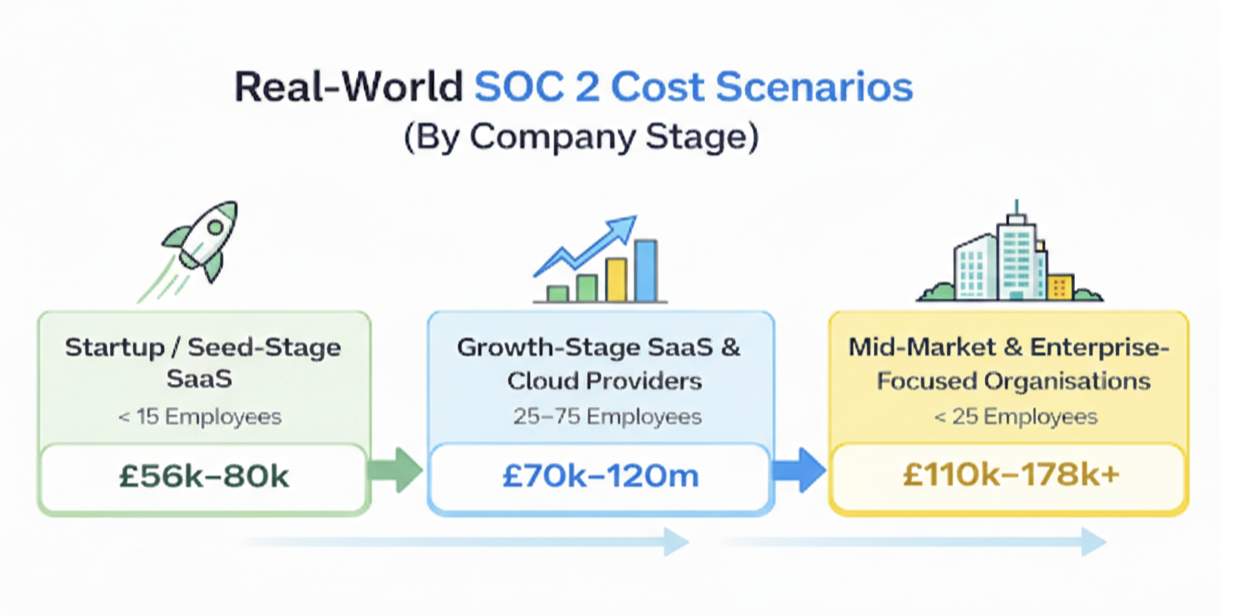
1. Startup/Seed-stage SaaS (≤15 Employees)
For early-stage SaaS companies, SOC 2 is often driven by the need to unblock deals or satisfy an initial enterprise prospect.
- Typical total cost range: Around £56,000-£80,000 [refer to the table at the top for components], (bearing in mind that much of this cost will be the cost of internal resources - so may not be directly “payable” costs) assuming a tight scope and a smaller audit.
- Time to completion: Usually 2-4 months for Type 1, depending on readiness.
- Lean scoping approach: One core product, limited systems, and a narrow Trust Services scope help keep costs down.
- Common pitfalls: Over-scoping too early, underestimating internal staff time, or rushing into Type 2 before controls are stable.
For many startups, SOC 2 Type 1 acts as a stepping stone rather than a final destination.
2. Growth-stage SaaS & cloud providers (25–75 Employees)
At this stage, SOC 2 becomes more structured and more demanding, both technically and commercially.
- Typical total cost range: Often £70,000–£120,000, (bearing in mind that much of this cost will be the cost of internal resources - so may not be directly “payable” costs) reflecting broader systems and higher internal effort.
- Team involvement: Security, engineering, operations, and leadership are all involved, not just one owner.
- Multi-system environments: Multiple cloud platforms, tools, and integrations increase audit effort.
- Scope expansion risks: Adding too many systems or criteria too quickly can push costs and timelines up sharply.
Growth-stage companies are where SOC 2 costs often rise faster than expected if the scope is not carefully managed.
3. Mid-market & enterprise-focused organisations
For more mature organisations selling into enterprise or regulated markets, SOC 2 is often non-negotiable.
- Typical total cost range: Commonly £110,000–£178,000+, depending on complexity.
- Multi-system and multi-vendor complexity: Multiple products, vendors, and internal teams significantly increase audit and preparation effort.
- Increased buyer scrutiny: Customers expect detailed reports, consistent controls, and often Type 2 as standard.
- Big 4 (4 largest global audit firms) vs mid-tier auditor impact: Larger audit firms often charge more, while mid-tier auditors can offer a more pragmatic, cost-controlled approach.
At this level, SOC 2 is as much about commercial credibility as it is about compliance.
Hidden & underestimated SOC 2 costs
Many SOC 2 budgets fail not because audit fees are wrong, but because indirect and hidden costs are missed. These costs build up quietly across teams, timelines, and rework, and often appear only after the audit is already underway.
1. Lost productivity & context switching
SOC 2 places a real demand on internal teams, especially engineering and senior leadership. Time spent answering auditor questions, gathering evidence, and explaining systems pulls people away from day-to-day work. This constant context switching slows delivery and decision-making.
To estimate internal cost more accurately, organisations should track hours across engineering, security, operations, and leadership over the full audit period.
When this time is not planned for, productivity losses quickly inflate the true cost of SOC 2.
2. Failed or delayed audits
Delays are another common cost driver.
Failed or incomplete audits can lead to re-audit fees, extended evidence windows, or longer observation periods, especially for Type 2 audits.
Each delay pushes timelines out and keeps teams in audit mode for longer than expected.
These knock-on effects often impact sales cycles, renewals, and customer trust, adding commercial pressure on top of direct audit costs.
3. Poor scoping decisions
Over-scoping is one of the most expensive mistakes organisations make. Including too many Trust Services Criteria or auditing low-risk systems increases audit effort without adding buyer value.
Poor early scoping decisions can also lock businesses into unnecessary future scope. This raises costs year after year.
4. Evidence rework & control drift
Manual evidence collection often creates duplication, with teams gathering the same information in different ways and reworking it multiple times.
When controls are not clearly defined or slowly drift as systems change, those gaps surface late in the audit and take months to correct. This ongoing remediation adds both cost and fatigue, stretching teams well beyond what was originally planned.
A more collaborative audit approach, combined with clear ownership and consistent controls, reduces unnecessary rework and helps keep SOC 2 costs far more predictable over time.
Annual maintenance & long-term SOC 2 costs
Many organisations treat SOC 2 as a one-off project, but in reality, it is an ongoing commitment.
Long-term SOC 2 costs depend on how well controls are maintained and how much the business continues to change.
Understanding these ongoing costs early helps avoid surprises in year two and beyond.
1. Annual SOC 2 audit costs (Year 2+)
After the first year, SOC 2 audit fees usually become more predictable.
Recurring audits are often smoother because controls are already in place and evidence structures are familiar. For many UK and European organisations, this means audit effort reduces slightly compared to year one.
However, not everything gets cheaper. While setup work and initial documentation typically reduce, audit fees themselves do not disappear. The scope still needs to be tested, evidence still reviewed, and controls still validated over time.
If the scope has grown or if controls have changed significantly, audit effort and cost can remain similar to the first year.
In short, year two is usually easier, but rarely effortless.
2. Continuous monitoring & control testing
SOC 2 requires controls to work consistently, not just at audit time. This means ongoing evidence collection throughout the year. Logs, access reviews, change records, and incident management evidence all need to be maintained continuously.
Organisations that rely heavily on manual evidence collection often find this time-consuming and expensive. Manual processes increase the risk of gaps and rework.
By contrast, tooling can reduce effort, but it still requires internal ownership. Someone must review alerts, validate evidence, and confirm controls are operating as intended.
SOC 2 maintenance is not “set and forget”. Internal ownership remains essential, even with the right tools in place.
3. Cost of change (New systems, vendors, teams)
One of the biggest long-term cost drivers is change. As organisations grow, the SOC 2 scope rarely stays static.
New products often bring new systems and data flows that need to be assessed against existing controls. Changes to cloud infrastructure can also trigger updates to documentation and control design, even when the overall security approach remains unchanged.
Onboarding new vendors adds another layer, as each supplier requires risk reviews and contract checks. While these changes may seem small in isolation, they add incremental effort over time.
Mergers, acquisitions, and geographic expansion introduce even more complexity. New teams, regions, and regulatory expectations expand audit scope and increase the need for coordination.
These costs are rarely obvious at the start, but they are one of the most common reasons long-term SOC 2 budgets grow year after year.
The long-term view
SOC 2 costs are lowest when controls are stable, ownership is clear, and change is managed carefully.
For UK and European organisations, treating SOC 2 as an ongoing operational discipline, rather than a yearly scramble, is the most effective way to keep long-term costs under control.
Plan your SOC 2 audit with clarity and confidence
If you are considering SOC 2 for your UK or European business, working with the right audit partner makes a measurable difference. Tempo Audits' audit-led, practical approach supports both Type 1 and Type 2 engagements and aligns with UK and European expectations, as well as US buyer requirements.
Learn how Tempo Audits can support your SOC 2 journey. Drop an email at hello@tempoaudits.com.
Is SOC 2 worth the cost for UK or European tech companies?
SOC 2 is a significant investment, both financially and operationally. For some UK and European tech companies, it delivers clear commercial value.
For others, it can be expensive, distracting, and premature. Understanding when SOC 2 genuinely pays off helps businesses make better timing and prioritisation decisions.
When SOC 2 delivers a clear ROI
SOC 2 delivers the strongest return when it directly supports revenue growth. For companies selling to US-based or enterprise customers, SOC 2 is often a baseline requirement rather than a differentiator.
Having a valid SOC 2 report can remove friction early in procurement and prevent deals from stalling at the security review stage.
It also reduces the burden of repeated security questionnaires. Instead of answering the same questions for every prospect, teams can rely on a recognised third-party report. This saves time across sales, security, and leadership and helps accelerate deal cycles.
Over the longer term, SOC 2 supports trust building. It shows buyers that security is not ad hoc, but embedded into how the organisation operates, which becomes increasingly important as deal sizes and customer expectations grow.
When SOC 2 is a poor or premature investment
SOC 2 is not always the right move, especially for very early-stage companies. If customers are not asking for it, the cost and internal effort can outweigh the benefits.
Businesses selling into low-security buyer markets, or those with no current or near-term US sales focus, often gain little commercial advantage from SOC 2. In these cases, lighter trust signals may be more appropriate.
SOC 2 also struggles to succeed without clear internal ownership. If no one can realistically maintain controls, collect evidence, and manage ongoing compliance, the process becomes painful and expensive, with limited return.
SOC 2 vs alternative trust signals
For many UK and European organisations, ISO 27001 is the primary alternative to SOC 2, particularly in Europe. ISO is often better recognised by European buyers and regulators and can provide broader, longer-term value if the organisation is not US-focused.
Other options include SIG (Standardized Information Gathering) or CAIQ (Consensus Assessment Initiative Questionnaire), which are lighter assessment frameworks often used to respond to customer security questionnaires without a full audit. Some companies also rely on customer-led security reviews, especially in niche or relationship-driven markets.
Each option signals trust differently. The right choice depends on where customers are based, how they buy, and what level of assurance they expect.
Related read - ISO 27001 vs. SOC 2: Which Certification is Right for Your Business?
The practical takeaway
SOC 2 is worth the cost when it directly supports sales, reduces friction, and aligns with buyer expectations. When it does not, alternative trust signals may deliver better value with far less strain.
For UK and European tech companies, timing and context matter as much as the certification itself.
How UK and European companies can reduce SOC 2 audit & compliance costs
Reducing SOC 2 costs is rarely about cutting corners. In practice, it comes down to making better decisions early, avoiding unnecessary complexity, and aligning effort with what customers actually expect.
The steps below reflect what consistently helps UK and European organisations keep SOC 2 spend under control.
1. Scope only what you need
One of the most effective ways to manage SOC 2 costs is to scope carefully from the start.
Many organisations include more Trust Services Criteria (security, availability, processing integrity, confidentiality, privacy) than necessary, often without a clear buyer-driven reason.
A “minimum viable” approach works best.
Start with the criteria your customers actually expect, rather than what might be needed in the future. Aligning scope with real customer requirements keeps audit effort focused and avoids unnecessary expansion.
Over-scoping early not only increases first-year costs but also locks businesses into higher ongoing costs year after year.
Tempo Audits CEO, Rob, notes, "For the majority of our SaaS / Tech customers, security is the core requirement. Anything on top is typically specific to the procurement process they're going through. With that in mind, we normally advise clients to focus on Security TSC, and then add in additional TSCs if there’s a specific demand."
2. Choosing the right auditor
Auditor choice has a direct impact on both cost and experience.
For most tech companies, especially SaaS and cloud providers, a tech-aware auditor reduces friction. Auditors who understand modern infrastructure spend less time interpreting systems and more time assessing controls, which often translates into smoother audits and fewer delays.
Tempo Audits combines deep technical understanding with practical audit experience, ensuring your SOC 2 audit is efficient, aligned with modern cloud environments, and tailored to UK and European business needs. Get in touch today to learn more.
3. Compliance automation - Understand the pros & limits
Compliance automation can reduce manual effort, particularly around evidence collection and tracking. Used well, it helps teams stay organised and reduces last-minute scrambles before audits.
However, automation does not remove the need for ownership. Tools cannot design controls, make judgment calls, or explain context to auditors.
Many companies overestimate how much automation will reduce internal workload, especially if controls are not clearly defined. Automation works best as a support layer, not a replacement for good processes.
4. When to use consultants (and when not to)
Consultants can be valuable in high-risk scenarios, such as complex environments, tight timelines, or organisations with limited internal security experience. In these cases, external expertise can prevent costly mistakes.
For lower-risk environments, consultants may add unnecessary cost. Many organisations benefit more from strong internal ownership and clear auditor guidance.
In well-scoped audits, auditors can often clarify expectations without stepping into a consulting role. The key is to assess whether the cost of external help is genuinely offset by reduced risk or time saved.
The takeaway
SOC 2 costs stay manageable when the scope is disciplined, auditors are chosen carefully, tools are used realistically, and external help is applied selectively.
For UK and European companies, the goal is not to do more, but to do what is necessary - and no more than that.
SOC 2 cost trends & forecast for 2026
SOC 2 costs are evolving as adoption increases and buyer expectations rise. For UK and European companies, 2026 will be shaped by auditor capacity, demand for technical expertise, and more scrutiny on audit quality rather than speed alone.
1. Focus on tech & human judgment
Demand is strongest for tech-specialist auditors who understand modern cloud and SaaS environments, as they reduce friction and rework.
Report quality is also under scrutiny. While automation and AI improve efficiency, buyers still value human judgment. Many organisations now prefer near-shore or local auditors over fully offshored models, and increasingly expect auditors to remain independent from GRC or automation platforms.
Tempo Audits CEO, Rob, observes that "There’s a race to the bottom in the SOC 2 market, being driven by AI, offshoring, and a decline in quality from new low-cost automated providers. With this in mind, increasingly procurement teams are looking at the quality of reports and auditing practices."
2. Increasing demand for SOC 2 Type 2
For companies selling into the US and enterprise markets, SOC 2 Type 2 is becoming the default, not a future goal. Buyers are less willing to accept point-in-time assurance (Type 1) and expect evidence of controls operating consistently.
At the same time, tolerance for control exceptions is falling, particularly around access management and change control.
This increases pressure on organisations to maintain controls year-round, not just during the audit window.
3. Automation, AI & the future of SOC 2 costs
As we move through 2026, expect automation and AI to become more integrated with audit workflows, but not to fully replace human auditors.
Practical adoption will continue to focus on hybrid models where technology collects and organises evidence, and humans interpret context and control effectiveness.
Organisations that overestimate what automation can eliminate will often see unexpected internal costs. A practical approach will help keep audit costs under control.
The future of SOC 2 costs
The market is being shaped by competing cost pressures. While some segments, such as the Big 4 audit firms, recorded an audit fee increase of 19.5% between 2022 and 2023, other forces, like the adoption of AI and offshoring, are driving prices down.
Nonetheless, overall audit fees are still likely to increase in the long term, even among firms that invest heavily in technology, as upfront costs for new tools, hiring and training skilled staff, and upgrading controls remain significant.
Get a transparent quote for your 2026 SOC 2 certification cost from Tempo Audits.
Reviews
Trusted by fast-moving tech teams across the world who value a more human audit experience.



FAQs
Trying to make sense of SOC 2? Here are the questions we get asked most by SaaS and tech teams.
The audit alone refers only to the independent auditor’s fee. In the UK and Europe, this usually sits at £10,000-£20,000 for small to mid-sized businesses and £30,000-£100,000+ for larger or more complex environments. It does not include preparation or internal costs.
The lowest-cost route is a tightly scoped SOC 2 Type 1 audit, focused on essential systems and the minimum Trust Services Criteria needed to meet customer expectations. Avoiding over-scoping and using existing controls effectively makes the biggest difference. It is advisable to consult experienced audit firms or auditors for an informed decision.
In terms of audit fees and tooling, yes - but when you include the cost of internal audit resources, probably not. While the audit fee alone may fit within that range, total SOC 2 costs, including internal time, tools, and preparation, usually exceed £30k. Claims below this often exclude significant hidden costs.
Big 4 firms often charge higher fees because of their brand reputation, larger delivery teams, and more structured audit processes. For some enterprise buyers, that name recognition carries weight. However, many tech companies find that mid-tier or specialist auditors deliver the same assurance with a more practical approach, fewer delays, and better overall value.
The decision depends on your business size, audit budget, and what your potential customers expect.
SOC 2 is not legally mandatory. However, for SaaS companies selling to enterprise or US customers, it is often a commercial requirement, as many buyers will not proceed without it.
Often, yes. Many US enterprises expect SOC 2 as a baseline trust signal. While alternatives like ISO 27001 may work in Europe, SOC 2 is frequently required for US procurement and security reviews.
Yes. Most SOC 2 audits for UK and European companies are conducted fully remotely. Evidence reviews, interviews, and testing are typically handled online, especially for cloud-based businesses.
At Tempo Audits, we believe in remote-first audits with excellent customer support available every step of the way.
A Type 1 audit often takes 2-4 months, depending on readiness. A Type 2 audit takes longer due to the observation period and can run 6-9 months end-to-end.
You cannot “fail” SOC 2 in the traditional sense, but audits can result in control exceptions. These must be disclosed in the report and may reduce buyer confidence if not addressed properly.
Book a call
No forms, no faff – just a conversation and a quote. Prefer to skip straight to it? Fill out the application form and we'll get moving.
Alternatively, if you have all the details,
fill out this form here.