What Is ISO 27001? A Complete Guide to Information Security Standards

Understanding ISO 27001
ISO 27001 is the internationally recognised standard for information security management systems (ISMS). Published by the International Organisation for Standardisation (ISO) and the International Electrotechnical Commission (IEC), it provides a systematic framework for organisations to protect sensitive information, manage security risks, and build customer trust.
The standard specifies requirements for establishing, implementing, maintaining, and continually improving an ISMS. Rather than prescribing specific technologies or solutions, ISO 27001 takes a risk-based approach, allowing organisations of any size or industry to tailor their security controls to their unique context and threats.
For modern tech companies - especially SaaS providers and information technology businesses - ISO 27001 has become essential for demonstrating credible information security practices to customers, partners, and procurement teams.
How ISO 27001 Works
ISO 27001 centres on three core principles that underpin information security: confidentiality, integrity, and availability - often referred to as the CIA triad. Confidentiality ensures that information is accessible only to authorised individuals, integrity guarantees that data remains accurate and complete, and availability ensures that information and systems are accessible when needed.
The standard is built around a Plan-Do-Check-Act (PDCA) cycle, promoting continuous improvement. Organisations define their ISMS scope, conduct risk assessments, implement appropriate controls, monitor their effectiveness, and make ongoing improvements based on findings.
ISO 27001 is structured into two main parts. Clauses 4 through 10 define mandatory requirements for the management system itself - covering context, leadership, planning, support, operation, performance evaluation, and improvement. Annex A contains 93 information security controls organised into four themes: Organisational, People, Physical, and Technological. Companies select and implement the Annex A controls that are relevant to their specific risks and operational context, documented in a Statement of Applicability (SoA).
Key Benefits of ISO 27001 Certification
Achieving ISO 27001 certification delivers tangible business advantages that extend far beyond compliance checkboxes.
Opening New Revenue Opportunities: Many enterprise customers and public sector organisations require ISO 27001 certification before they will sign contracts or share sensitive data. For SaaS and technology companies, certification can be the difference between winning and losing major deals. It accelerates sales cycles by addressing security concerns upfront and satisfies procurement requirements in tenders and RFPs.
Reducing the Risk of Data Breaches: ISO 27001's structured risk management approach helps organisations identify vulnerabilities, implement appropriate safeguards, and respond effectively to incidents. This proactive stance significantly reduces the likelihood and impact of data breaches, which can carry severe financial and reputational costs.
Building Customer Trust and Market Differentiation: Certification signals to customers, partners, and stakeholders that an organisation takes information security seriously and adheres to international best practice. In competitive markets, it provides a clear differentiator and strengthens brand reputation.
Ensuring Legal and Regulatory Compliance: ISO 27001 aligns with many data protection regulations, including GDPR and industry-specific requirements. By implementing the standard's controls, organisations often satisfy multiple compliance obligations simultaneously, streamlining regulatory management.
The Certification Process
Obtaining ISO 27001 certification involves a structured audit process conducted by an accredited certification body.
Stage 1 Audit: The auditor reviews your ISMS documentation - including policies, risk assessments, the Statement of Applicability, and key procedures - to verify completeness and alignment with ISO 27001 requirements. This is a readiness check that identifies gaps before the formal assessment.
Stage 2 Audit: The certification audit evaluates whether your ISMS operates effectively in practice. Auditors interview staff, observe processes, review evidence of control implementation, and verify that your organisation follows its documented procedures. Successful completion results in certification, valid for three years.
Surveillance Audits: To maintain certification, organisations undergo annual surveillance audits that confirm continued compliance and effective operation of the ISMS. At the end of the three-year period, a recertification audit renews the certificate.
For fast-growing tech companies, working with a specialist auditor who understands modern technology stacks and startup realities can significantly streamline the process. Tempo Audits provides remote-first ISO 27001 audits tailored for SaaS and IT organisations, combining cyber security expertise with plain-English communication and collaborative support.
ISO 27001 Controls: Annex A Explained
Annex A of ISO 27001:2022 contains 93 security controls across four thematic areas, providing a comprehensive catalogue of measures organisations can implement to address information security risks.
Organisational Controls (A.5.1–A.5.37) cover governance, policies, asset management, supplier relationships, incident management, business continuity, and legal compliance. These controls establish the foundation for how security is managed across the organisation.
People Controls (A.6.1–A.6.8) address human factors in information security, including background screening, employment terms, security awareness training, disciplinary processes, and responsibilities after employment ends.
Physical Controls (A.7.1–A.7.14) protect premises, equipment, and information from physical threats through measures like secure perimeters, access controls, equipment security, clear desk policies, and secure disposal.
Technological Controls (A.8.1–A.8.34) encompass IT security measures such as access control, encryption, network security, secure development practices, logging and monitoring, backup, and vulnerability management.
Organisations are not required to implement all 93 controls. Instead, they conduct a risk assessment to determine which controls are necessary and relevant to their specific context, documenting the rationale for inclusion or exclusion in the Statement of Applicability.
Who Needs ISO 27001?
ISO 27001 is relevant for any organisation that handles sensitive information, but it is especially important for certain sectors and business models.
SaaS and Cloud Service Providers: Companies that store, process, or transmit customer data face intense scrutiny from enterprise buyers and partners. ISO 27001 certification is often a prerequisite for enterprise contracts.
Financial Services and Fintech: Banks, payment processors, and financial technology companies operate in highly regulated environments where information security is paramount.
Healthcare and Life Sciences: Organisations handling patient data and health information require robust security controls to protect privacy and meet regulatory obligations.
Data Processing and Analytics Platforms: Any business that processes data on behalf of customers must demonstrate strong security practices and risk management.
Professional Services and Consultancies: Firms handling confidential client information benefit from certification to assure clients of secure data handling.
For technology companies experiencing rapid growth, implementing ISO 27001 early can prevent security debt, embed best practices into operations, and remove friction from sales processes as the customer base scales.
ISO 27001 vs. SOC 2: Understanding the Difference
Both ISO 27001 andSOC 2 are widely recognised information security frameworks, but they differ in origin, scope, and audience.
ISO 27001 is an international standard with global recognition, particularly in Europe, the UK, and the Asia-Pacific markets. It covers a broad range of security, availability, confidentiality, and compliance concerns through a comprehensive set of controls. Certification is binary - you either meet the standard or you do not - and is issued by accredited certification bodies.
SOC 2, developed by the American Institute of Certified Public Accountants (AICPA), is more common in North America and focuses on five Trust Services Criteria: Security, Availability, Processing Integrity, Confidentiality, and Privacy. SOC 2 reports are produced by CPA firms and shared directly with stakeholders, rather than resulting in public certification.
Many global tech companies pursue both frameworks to address diverse customer requirements across geographies and industries. Some controls and processes overlap, allowing organisations to leverage work done for one framework when pursuing the other.
Getting Started with ISO 27001
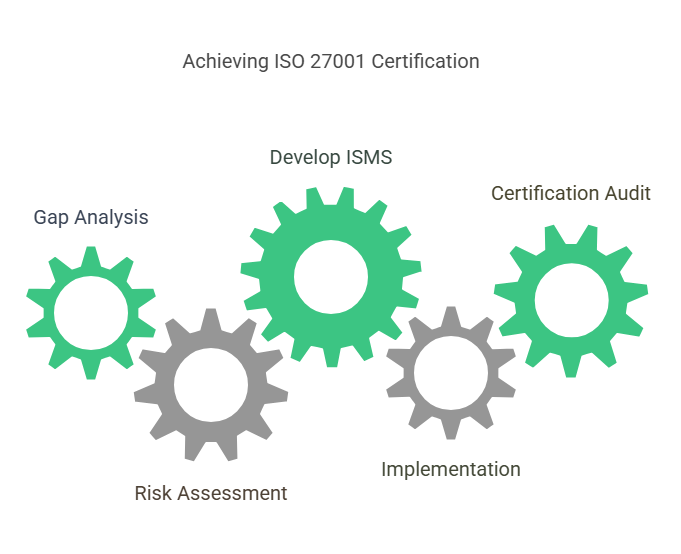
Implementing ISO 27001 begins with securing leadership commitment and defining the scope of your ISMS - which systems, locations, and processes will be covered.
Next, conduct a comprehensive risk assessment to identify information security threats, vulnerabilities, and impacts. This informs the selection of controls from Annex A and the development of your Statement of Applicability.
Develop core ISMS documentation, including an information security policy, risk treatment plan, and procedures for key processes like incident management, access control, and business continuity.
Implement the selected controls and train staff on their security responsibilities. ISO 27001 emphasises that security is everyone's responsibility, not just the IT team's.
Conduct internal audits to verify that your ISMS operates as intended, then engage an accredited certification body to perform the formal audit.
For organisations new to information security frameworks, working with experienced auditors can streamline implementation and ensure that the ISMS is both practical and audit-ready.
Tempo Audits specialises in supporting fast-growing tech companies through ISO 27001 certification with a remote-first, collaborative approach that reduces friction and accelerates time to certification.
Conclusion
ISO 27001 provides a robust, internationally recognised framework for managing information security risks and building trust with customers, partners, and regulators. For modern SaaS and technology companies, certification is increasingly essential for accessing enterprise markets, demonstrating security maturity, and differentiating in competitive landscapes.
While the implementation journey requires investment in time and resources, the benefits - ranging from reduced breach risk to accelerated sales cycles - make ISO 27001 a strategic asset for organisations serious about information security and sustainable growth.
Whether you're just starting your compliance journey or preparing for your next audit cycle, working with an auditor who understands modern tech stacks, distributed teams, and fast-moving startups makes all the difference. Tempo Audits was built specifically for teams like yours—offering UKAS-accredited ISO 27001 audits, remote-first delivery, plain-English communication, and a collaborative approach designed to help you find conformity while strengthening your information security posture.


Book a call
No forms, no faff – just a conversation and a quote. Prefer to skip straight to it? Fill out the application form and we'll get moving.
Alternatively, if you have all the details,
fill out this form here.